Intervention Builder
When your team is stuck, here's where to start
Team dysfunction doesn't fix itself. Lead-well helps you diagnose what's really going on, match it to the right framework, and build a concrete intervention plan — before it gets worse.
The problem
Managers see the dysfunction — but don't know where to start
You can feel when a team isn't working. Low trust, passive conflict, a lack of accountability — the signs are there. But knowing what's wrong and knowing what to do about it are two very different things.
Lead-well bridges that gap. It helps you accurately diagnose the dysfunction and gives you a framework-backed, step-by-step plan to address it.
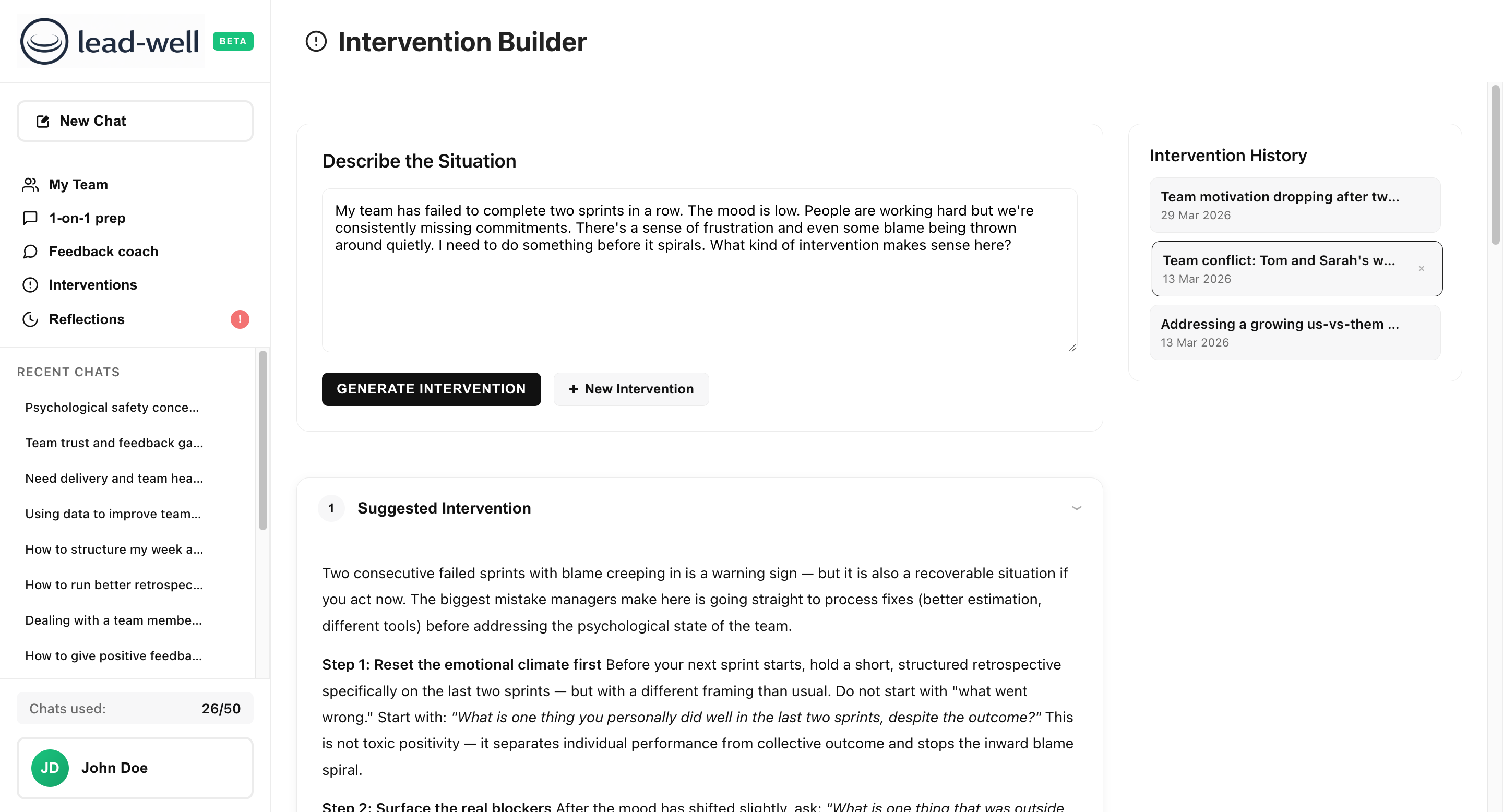
How the Intervention Builder works
From vague dysfunction to concrete action plan — with a framework to back it up.
Describe what you're seeing
Tell Lead-well what's happening in your team — the behaviours, patterns, and dynamics you've noticed. No structure required.
Get a dysfunction diagnosis
Lead-well maps your situation to a proven framework and surfaces the root cause — what the dysfunction is actually about, not just the symptoms.
Receive a structured action plan
A tailored, step-by-step intervention plan based on your specific situation, team context, and the type of dysfunction identified.
The dysfunctions Lead-well helps you address
Each type of dysfunction requires a different diagnosis and a different approach. Lead-well knows the difference.
Absence of trust
Team members won't admit mistakes or ask for help. Everything is guarded. Lead-well helps you create the conditions for psychological safety — the foundation everything else builds on.
Avoidance of conflict
The team agrees in meetings and disagrees in the corridor. Issues fester. Lead-well helps you introduce productive conflict — the kind that leads to better decisions, not resentment.
Lack of accountability
Commitments aren't followed through. Standards slip. People avoid calling each other out. Lead-well helps you build a culture where accountability is the norm, not the exception.
Interpersonal conflict
Two people on your team are in open or passive conflict, and it's affecting the whole team. Lead-well builds a facilitated resolution plan that addresses both the relationship and the root issue.
Framework-grounded
Built on research, not instinct
Lead-well's Intervention Builder draws on decades of organisational psychology and team effectiveness research. Your intervention plan isn't built on gut feeling — it's grounded in the frameworks that have helped thousands of teams.
The AI matches your situation to the right model, explains why, and builds a plan from there — so you understand the reasoning, not just the steps.
Five Dysfunctions of a Team
Lencioni's foundational model for diagnosing team failure across five interconnected layers.
Psychological Safety research
Edmondson's research on the conditions that enable teams to take risks and learn together.
Conflict resolution models
TKI and interest-based frameworks for navigating interpersonal and team-level conflict.
Situational leadership
Matching your intervention approach to the maturity and context of the specific team and issue.
"I'd been watching the same team dynamic play out for months and had no idea how to intervene. Lead-well gave me a plan I could actually execute — and it worked."
Early user — VP of Product
Common questions
What is a team intervention?
A team intervention is a deliberate, structured manager action designed to address dysfunction, conflict, or breakdown in a team. It involves diagnosing the root cause, selecting the right approach, and executing a sequence of steps with the goal of restoring trust, alignment, or performance.
How is the Lencioni Five Dysfunctions model used here?
Patrick Lencioni's Five Dysfunctions model identifies five root causes of team failure: absence of trust, fear of conflict, lack of commitment, avoidance of accountability, and inattention to results. Lead-well uses this model (alongside others) to diagnose which layer your team is struggling with, then builds an intervention plan from that diagnosis.
Does this work for small teams, not just large organisations?
Yes. The Intervention Builder works for teams of any size — including small teams of 3–5 people where interpersonal dynamics are intense and problems escalate quickly. The plan Lead-well generates is calibrated to the size, context, and nature of the issue you describe.
What if I'm not sure what's actually causing the dysfunction?
That's exactly what the Intervention Builder is for. You don't need to have already diagnosed the problem — just describe what you're seeing and experiencing. Lead-well helps you get to the root cause and then builds the plan from there.
The Framework Library
11 proven models powering Intervention Builder
The Intervention Builder doesn't guess — it draws on 11 robust frameworks from organisational psychology, conflict resolution, and team effectiveness research. Here are 6 of them.
Five Dysfunctions of a Team
Patrick Lencioni
Five interconnected causes of team failure: absence of trust, fear of conflict, lack of commitment, avoidance of accountability, and inattention to results.
Psychological Safety
Amy Edmondson
Shared belief that the team is safe for interpersonal risk-taking — the foundation for learning, innovation, and high performance.
Thomas-Kilmann Conflict Model
Thomas & Kilmann
Five conflict-handling modes — competing, collaborating, compromising, avoiding, accommodating — each suited to different situations.
Crucial Conversations
Patterson et al.
Techniques for high-stakes conversations where opinions differ and emotions run high — making it safe to talk about anything.
Tuckman's Stages
Bruce Tuckman
Forming, Storming, Norming, Performing — the natural lifecycle of team development and what each stage needs from a manager.
Trust Equation
Maister, Green & Galford
Credibility + Reliability + Intimacy divided by Self-Orientation. The formula that explains why some leaders are trusted and others aren't.
Plus 5 more models — interest-based negotiation, mediation, restorative conversations, social loafing, and groupthink — part of the 50+ framework library powering Lead-well.
Don't wait for the dysfunction to fix itself
Free to start. No credit card. Private by design.