Weekly Reflection
Close every week with clarity — not just exhaustion
Most managers rush from week to week without ever stepping back. Lead-well gives you a structured five-minute reflection that builds self-awareness, surfaces patterns, and sets a clear intention for the week ahead.
The problem
The weeks blur into each other — and nothing changes
Without a moment to pause and reflect, managers repeat the same mistakes, carry the same blindspots, and never notice the patterns shaping how they lead. The intention to improve is there — the structure isn't.
Lead-well gives you that structure. Five minutes at the end of each week — enough to shift from reactive to intentional.
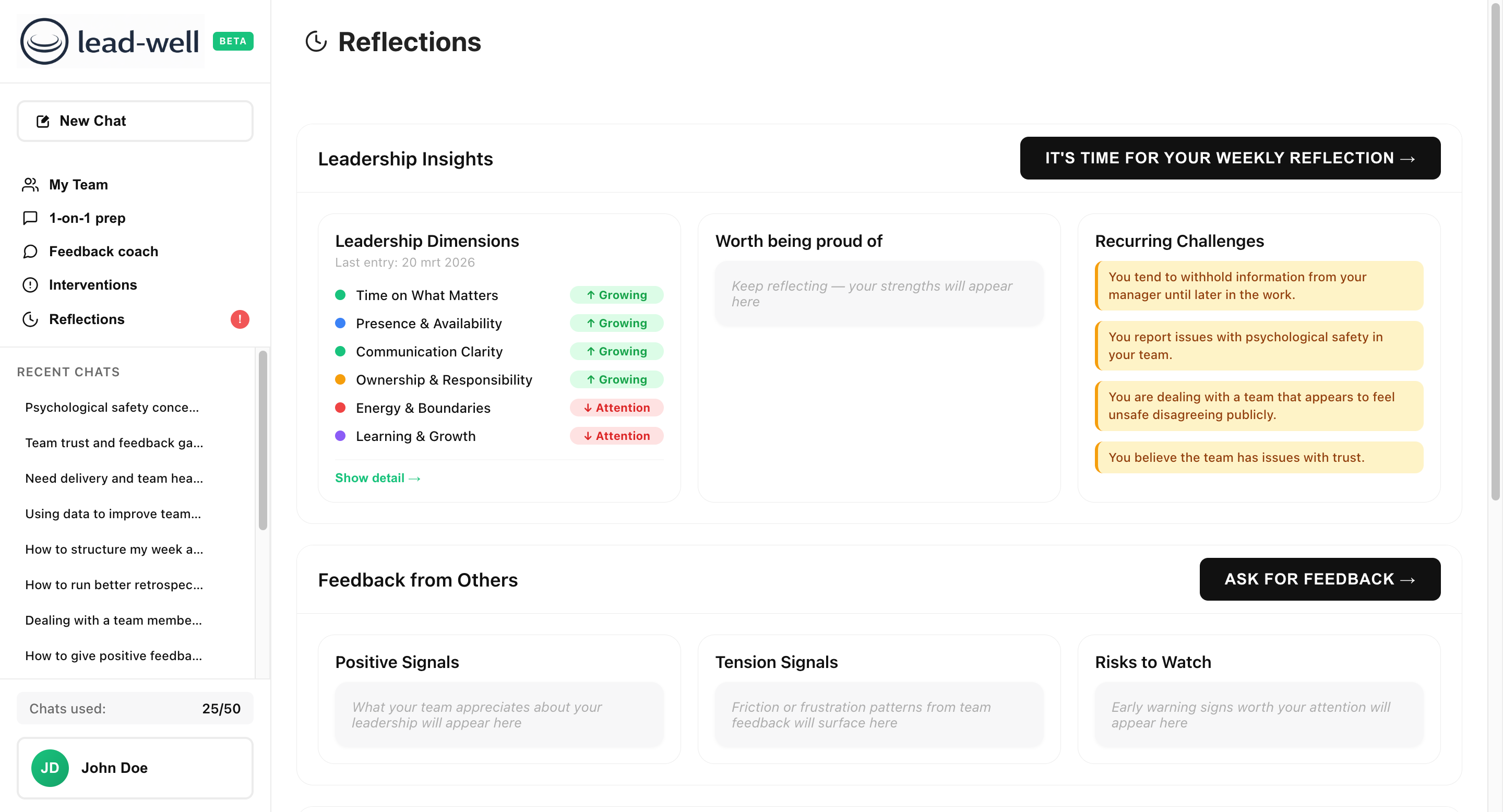
How Weekly Reflection works
A lightweight ritual that pays off every week — and compounds over time.
Rate your week
Score yourself on a set of leadership dimensions — honestly, from 1 to 10. No one sees this but you.
Add context
A few sentences on what drove each rating. What happened? What was behind the score?
Get your reflection
Lead-well generates a personalised reflection based on your ratings and context — surfacing what matters and what to watch.
Set one intention
End with a single, clear intention for next week. One focus. Not five goals — one thing.
The leadership dimensions you'll reflect on
Each dimension is a meaningful measure of how you showed up as a leader that week.
Communication clarity
Were you clear in how you communicated expectations, decisions, and direction to your team?
Team support
Did you unblock, enable, and support your team effectively — or were you a bottleneck?
Decision quality
Were the decisions you made this week sound? Were they timely? Did you get the right input?
Presence and focus
Were you genuinely present in conversations, or distracted and disengaged?
Recognition and acknowledgement
Did you recognise good work specifically and meaningfully — or let it pass unnoticed?
Leadership energy
What energy did you bring to the team? Were you driving momentum or draining it?
Leadership Memory
Your reflections build a picture of your leadership over time
Every time you complete a weekly reflection, it's saved to your private Leadership Memory. Over weeks and months, this becomes a rich, personal record of how you've been showing up — which dimensions you consistently struggle with, where you've genuinely improved, and what intentions actually translated into change.
This memory also feeds directly into Lead-well's AI coaching — so when you bring a challenge to the coaching chat, the AI already understands your leadership context and can give you more relevant, personalised guidance.
Every reflection is stored privately
Your weekly scores and context are saved and linked to your account — visible only to you, never to your employer or HR.
Patterns surface over time
After a few weeks, Lead-well starts to show you where you consistently score high or low — not as a judgment, but as a signal.
Intentions become a record
Each weekly intention is logged. Over time you can see which ones stuck and which ones quietly disappeared — honesty that drives real change.
Powers richer AI coaching
Your reflection history becomes context for Lead-well's AI coaching. Conversations are more relevant because the AI already knows your patterns.
Compounded growth
One reflection is helpful. Twenty is transformative.
The real value of Lead-well's weekly reflection isn't any single week — it's the pattern that emerges over time. You start to see which dimensions you consistently score low on, which intentions you actually follow through on, and where your leadership has genuinely shifted.
Spot recurring blindspots
Dimensions you keep rating low aren't a bad week — they're a pattern worth addressing.
Track what's actually improving
See the real trajectory of your leadership — not just what you intend, but what's changing.
Intentions that connect to growth
Your weekly intentions become a record of what you were working on — and whether it landed.
Feeds into your AI coaching
Reflection data contributes to Lead-well's Leadership Memory, making AI coaching conversations richer and more contextual.
"I always thought I reflected on my week. I didn't. Lead-well showed me the difference between ruminating and actually learning from it."
Early user — Director of Engineering
Common questions
Why should managers do a weekly reflection?
Weekly reflection is one of the highest-leverage habits for leadership development. It shifts you from reactive to intentional — helping you notice patterns, course-correct faster, and lead with more consistency. Managers who reflect regularly tend to develop self-awareness faster than those who rely on annual reviews alone.
How long does a Lead-well weekly reflection take?
Between five and fifteen minutes, depending on how much context you add. You rate yourself on a set of leadership dimensions, write a few sentences on what drove each score, and Lead-well generates a reflection and one intention. Short enough to do every week. Structured enough to mean something.
What leadership dimensions does Lead-well assess?
Lead-well reflects on communication clarity, team support, decision quality, presence, recognition, and leadership energy — dimensions that cover the full picture of how a manager showed up that week. Each is rated 1–10 with optional context.
Does anyone else see my reflections?
No. Your weekly reflections are completely private to you. Lead-well never shares your data with your employer, HR, or anyone else. Your reflections are for your growth — not for performance review.
The Framework Library
6 proven models powering Weekly Reflection
Lead-well's weekly reflection is built on the most effective frameworks for structured self-assessment, experiential learning, and intentional growth — so five minutes of reflection actually means something.
Gibbs Reflection Cycle
Graham Gibbs
Six stages — description, feelings, evaluation, analysis, conclusions, action planning — that turn raw experience into genuine learning.
Kolb Learning Cycle
David Kolb
Concrete experience → reflective observation → conceptual abstraction → active experimentation. The loop that makes experience developmental.
WOOP
Gabriele Oettingen
Wish, Outcome, Obstacle, Plan. Mental contrasting that bridges the gap between good intentions and actual follow-through.
Leadership Agility
Joiner & Josephs
Developmental stages from expert to catalyst — each with broader situational awareness and more nuanced leadership repertoire.
Action Learning
Reginald Revans
Learning from real problems with colleagues through structured questioning and peer reflection — not classroom theory.
After Action Review
US Army
Structured debrief of what was supposed to happen, what did happen, why it differed, and what to do differently next time.
These 6 are the core reflection models — part of the 50+ framework library powering Lead-well across all tools.
Make reflection a weekly habit — starting this Friday
Free to start. No credit card. Private by design.